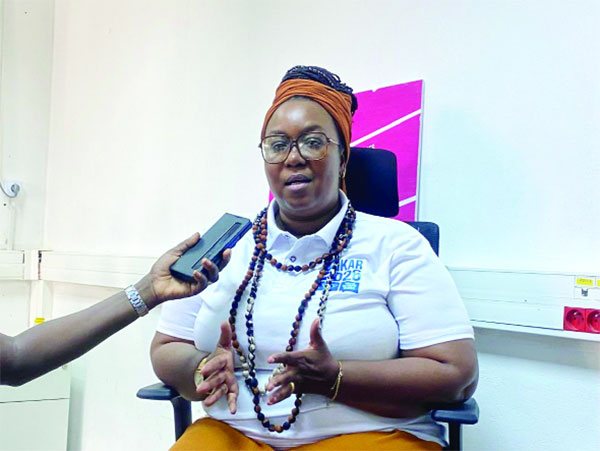
After more than a year of preparation behind the scenes, away from prying eyes, the Directorate of Ceremonies for the Youth Olympic Games (YOG) “Dakar 2026” is ready for the opening, scheduled for this Saturday, 31 October, at the Abdoulaye Wade Stadium in Diamniadio. A few hours before a ceremony conceived as African and produced by Africans, the Director of Ceremonies for the YOG, Khady Niang, assures in this interview that everything is fully ready to give the Olympic world historic moments in the land of Teranga.
What should we expect from the opening ceremony of the Dakar 2026 Youth Olympic Games?
The opening ceremony will take place at the Abdoulaye Wade Stadium in Diamniadio on 31 October, from 6.30pm to 8pm. It will be broadcast, and will therefore last an hour and a half. As you can well imagine, I cannot go into that subject. But what I can tell you is that within the Cojoj “Dakar 2026”, we very quickly decided to define the artistic concept in-house. Usually, for ceremonies, production is entrusted to a company, most of the time an international one, that is used to organising this type of event. But we told ourselves that we had a unique opportunity to tell our own story. It was very important to me, a year and a half ago, to choose a Senegalese artistic director. I really wanted, for once, at an African ceremony, the first Olympic ceremony organised on the continent, for this story to be a reclaiming of our narrative. That was very important to us. So what can be expected, to answer your question, is a ceremony produced 100% by Africans, in order to reclaim their narrative and tell the world who we are, where we come from and where we want to go.
What do you want to highlight?
What we want to tell is simple. I would not say that we want to tell the history of Senegal in brief, because I do not have that pretension. The history of Senegal is very rich and very varied. Above all, it can be told in very different ways depending on the perspective of the person telling it. As Senegalese and African youth, we simply aspire to show the world who we are and where we come from. We also want to open up to Africa, as our slogan says: “Africa welcomes, Dakar celebrates.” What we want to tell of African history is our vision of that history, as it was handed down to us by our ancestors. It is a very personal story. Today, this ceremony could be told by any Senegalese. We would like all Senegalese to be able to see themselves in this narrative.
How does Senegal intend to showcase itself culturally and highlight its identity?
It is very easy, because Senegalese culture is very rich and very diverse. Of course, choices had to be made, that is certain. Senegalese culture cannot be told in an hour and a half. How do we showcase it? Through the narrative, the costumes, the music, the dance, but also a strong story that encompasses all of these elements. Nor did we want to do what is done at some ceremonies, with simply a succession of celebrities coming on to sing, accompanied by dancers. We really chose to tell a story.
Will all of Senegal’s regions be represented, as was done for the Olympic Flame relay?
All of Senegal’s regions will be represented. That is a guarantee I can give you. They will be represented in the artistic tableaux, but also through the casting. You should know that we held castings in the various regions of Senegal. We selected no fewer than 625 dancers who will take part in the ceremony. If you add the extras, actors and singers, we arrive at around 1,100 performers. So we truly went out into the regions of Senegal to hold large-scale castings and to be inclusive. In that regard, we also worked with Special Olympics, which took part in the casting. People with reduced mobility will thus be part of the show. I can even tell you an anecdote: Special Olympics had asked us whether it would be possible to set aside, for example, a small two-minute show for them. We said no. We told them that we would integrate them into the show as a whole.
For me, inclusivity does not mean setting these people apart. In the show, they will be just like all the other performers. They are every bit as intelligent and talented, and that is what they are going to show at this ceremony.
What place will Africa have in this ceremony?
A very large place. I can even reveal an exclusive piece of information to you: it is a directive from His Excellency the President of the Republic. In our first discussions about this ceremony, he told us straight away that he wanted all Africans to feel concerned by and part of this event. He did not want us simply to organise a Senegalese-style ceremony. It had to be an African ceremony.
How long did it take you to prepare this ceremony?
It took us no less than a year and a half. We worked discreetly and in silence. You should know that the first version of the artistic concept for this ceremony was presented in September 2025. The final version was then presented to the President of the Republic. It is a tradition: the President of the Republic personally approves the concept of the opening ceremony, because ultimately it is the country’s image that is at stake. The concept was thus approved by the President of the Republic as early as February, and rehearsals began, with the training of the lead choreographers, during that same month.
Is it possible to have an estimate of the budget for the opening ceremony?
It is difficult for me to answer that question, because I do not know whether I am authorised to disclose that information. In any case, what I can tell you today is that, according to the IOC, this ceremony offers the best value for money in the history of the YOG. When we talk about cost-effectiveness, it is about the ratio between quality and price. So we really banked on Senegalese ingenuity… It is a ceremony on a human scale. This approach has today earned us the encouragement and congratulations of the IOC, which considers that we have produced the most cost-effective ceremony in the history of the YOG in terms of value for money.
What difficulties did you encounter during this period?
As for the difficulties, the first were operational. That is entirely normal. The IOC actually explained it to us: these are difficulties faced by all the organising committees and all the ceremonies directorates of the YOG. Why? Because we banked on local talent, on people who had never organised an Olympic ceremony. We therefore chose young, local teams who lacked experience. They had to be trained and a suitable working framework had to be created, in collaboration with the various ministries, notably those of Culture and Sport, which gave us a great deal of support, as well as with the IOC. So operational difficulties did indeed exist. Nor do I hide the budgetary difficulties. Today we are talking about a success, but it was first and foremost a challenge. An Olympic ceremony held in a 55,000-seat stadium inevitably comes at a cost, and at the outset we did not have the necessary budget. So solutions had to be found.
Could you have held the ceremony outdoors, as in Paris in 2024?
Yes, it was an internal choice that predates my appointment. That decision was taken at the time of Senegal’s bid, or perhaps a little after. You have to understand one thing: we are organising the Youth Olympic Games, not the Olympic Games.
Can we get an idea of the dignitaries and personalities expected at this ceremony?
I am not authorised to tell you about the dignitaries expected, as that question falls under the protocol department. What I can tell you, however, is that more than ten heads of state and government have confirmed their attendance. Our colleagues in protocol will be able to give you more details. We also have ambassadors within “Dakar 2026”, such as Omar Sy and Khaby Lame. Many international and national personalities will be present. For me, Senegal’s national ambassadors are just as important and just as much of an asset. So we will have a great many personalities at this ceremony. I can also tell you that this ceremony could be the most watched in the history of the YOG, in terms of broadcasting.
Do you have any idea who the final bearer of the Olympic Flame will be?
I know who the final torchbearer is. I am the only one who knows, but I will not reveal it.
Can we at least know their profile?
It will be a sportsman or a sportswoman, that is certain. It will also be a Senegalese man or woman. Those are two things I can state without fear of being wrong.
What about the artists who will take part in the show? Can we have a few names?
As for the show and the artists who will perform, there will be Senegalese and African artists. That does not get you much further, I admit, but we have a fine artistic line-up.
What message would you like to give the Senegalese about getting to the stadium?
We want them to understand that this is an exceptional format. An Olympic ceremony is not a football match where you go to the Abdoulaye Wade Stadium arriving at 4pm to watch a match at 5pm. There is a very precise transport plan. My first piece of advice to the Senegalese, then, is to come to the stadium very early. We are going to put on activities that will allow them to wait in very good conditions. There will be pre-shows, concerts and marketing activations to make their experience even more enjoyable. We also recommend that they use public transport. It will be a far more pleasant experience than coming by car, and it will also make our operations easier. Imagine a 55,000-seat stadium: if every person comes with their own car, or if two people share a car, it risks complicating movement. We would therefore prefer spectators to come in groups, notably in 55-seat buses. What I can tell you is that spectators who arrive at the stadium early, from 2pm, 3pm or 4pm, will not be bored. They will even be treated to surprises that those who arrive later will regret having missed. There will be concerts, very interesting activities, marketing activations and gifts. That is all we ask of the Senegalese: to come early and to come with the image we know of Senegal, that of Teranga. Let us celebrate together and show the world the best face of our country.
Can it be said that all arrangements have been made and that you are 100% ready for this opening ceremony?
We are ready. I can say that clearly. As I speak to you, I have come to meet you while already set up at the Abdoulaye Wade Stadium. The dancers are doing their final rehearsal. Everything is ready: the music, the costumes and the set design. Everything is absolutely ready. We are currently making the final adjustments on site, particularly to the lighting. As I explained to you, we have been rehearsing since February. So we took the time we needed, based on a very clear strategy. All that remains is for us to deliver this ceremony.
Interview by Woury [email protected]
Comments (0)
Be the first to comment.
Sign in to comment